
How often do you complain that you haven’t got enough time to do everything you want or need to do?
Unfortunately, clock synchronisation cannot magically create more hours in the day. It can, though, help you make better use of the time that you have got.
In this blog, we look at the definition of clock synchronisation and the different methods of achieving it. We examine three challenges of clock synchronisation and how to overcome them, as well as giving advice on how to choose the right clock system for you.
Overview
Clock synchronisation keeps every clock, server and system on your site running at the exact same time, helping to reduce errors, improve efficiency and support compliance.
- A master clock distributes a single, accurate time reference across your entire network.
- NTP, GPS and RDS are among the most common methods used to synchronise time.
- Network delays, clock drift and single points of failure are some of the key challenges to consider.
- Accurate, synchronised time is essential across a wide range of sectors, including healthcare, finance, education, manufacturing and public transport.
- Choosing the right clock depends on its intended environment, display requirements and available connection method.
Early methods of measuring time varied in their accuracy
The way we measure time has evolved significantly over the centuries. Sundials were one of the earliest time-measurement devices. A thin rod, or triangular piece of metal or stone, cast a shadow onto a flat surface marked with hour lines. This was very useful on sunny days. It was less helpful at night.
Water clocks measure time based on the flow of water into or out of a container, the markings on which indicate the passage of time. The Chinese used incense clocks, measuring time by the incense stick’s burn rate.
When mechanical clocks were invented, this was a great advancement. Using pendulums and gears, they kept time much more accurately although still not perfectly.
Fast-forward through other methods and inventions, and we come to the advent of the atomic clock in the 1950s. Today, sat nav systems like GPS rely on the precise time measurements from this incredibly accurate clock to function correctly.
Some of these early time-measurement devices will have been more accurate than others. One thing none of them were, however, is synchronised.
What is clock synchronisation?
Clock synchronisation aims to co-ordinate a network of clocks that otherwise would run independently from one another. It can also be known as time synchronisation.
Legal framework
"A man with one watch knows what time it is. A man with two watches is never sure."
Segal’s Law
How does clock synchronisation work?
For a fully synchronised clock network, you need a master clock. This precision electronic device sends reliable, consistent time signals to the clocks on its network so that they all simultaneously show the same, accurate time. These networked, or slave clocks, can be analogue or digital as synchronisation works on both.
Such co-ordination also means that the spring/autumn clock changeovers are automated, thereby saving you time and effort in an otherwise manual task.
As well as controlling time, a master clock can define when other systems are switched on and off, which can include heating, lighting, air conditioning or access control.
Why is clock synchronisation important?
Clock synchronisation is not just important, it’s critical. It ensures that your timekeeping devices, IT servers and systems are all running on the same timeline. Without it, you risk opening the networks up to data corruption, security vulnerabilities or compliance failures.
While clock synchronisation can benefit every industry, it is especially important in sectors where even the smallest timing discrepancies can have significant consequences.
Healthcare
Healthcare is one of the industries where time accuracy is imperative. In many cases, patient safety depends on precise time information. Births and deaths must be recorded accurately, medical procedures carried out at the right time, and patient observations completed according to schedule.
Financial services
The finance sector is a fast-moving and highly regulated environment where extremely accurate time signal across the whole business is vital to ensure transactions are correctly recorded and timestamped. In addition, as many financial institutions conduct business internationally, the accuracy is essential for smooth communication and co-ordination between branches.
Education
Keeping students on time throughout the day can quickly before a major logistical challenge for teachers and school staff. Synchronised and accurate clocks in schools therefore ensure that all lessons start and end on time, helping to reduce the amount of lost learning time and boost punctuality.
Manufacturing
Synchronising clocks and timers in the manufacturing sector helps to ensure shifts start and finish on time. Downtime is therefore reduced and business’ productivity as a whole improved.
We now get more production time. People know when it is time to go rather than finishing earlier. Everything is done in a more controlled manner, and everybody works a full day. It is a very good system.
Commercial Director, Leisure Furnishing Ltd
What are the different types of time synchronisation?
1. NTP Time Synchronisation
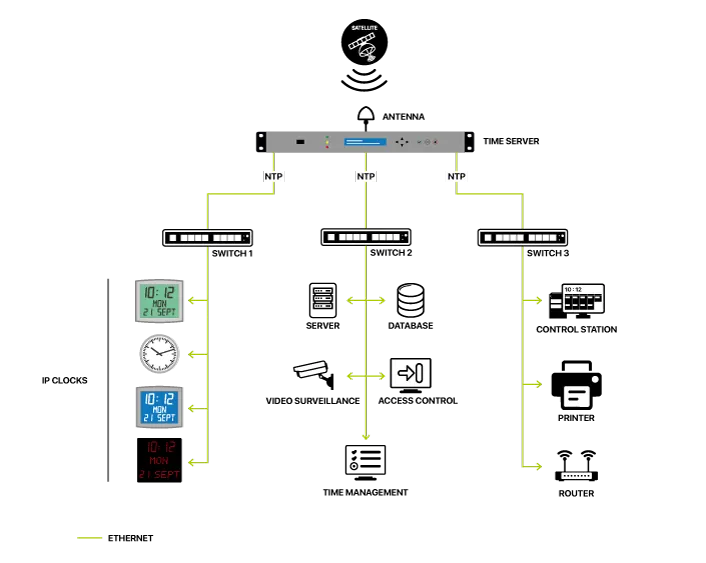
NTP stands for Network Time Protocol. It is an Internet Protocol (IP) that synchronises clocks to within a few milliseconds of Universal Co-ordinated Time (UTC). NTP allows networked devices like clocks or computers to request and receive time from a server, which in turn gets a precise time from a source, such as an atomic clock.
Definition
Coordinated Universal Time (UTC) is the international time standard against which all clocks and time zones are set — the modern, atomic-clock-based successor to Greenwich Mean Time (GMT).
Why use a time server? Using a time server ensures your computer’s clock is precise, which, as we have explained above, is vital for certain situations or industries. It can not only help protect your computer network -as it sits within your own firewall- but can also provide reliable timestamping, therefore boosting information traceability.

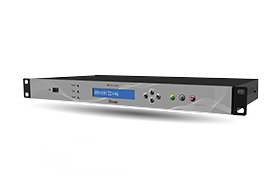
Keep control over your time network
Supervise and control your synchronisation from a centralised, user-friendly interface.
2. GPS Time Synchronisation
GPS (Global Positioning System) time synchronisation works on a similar principle to satellite navigation systems such as Google Maps. By receiving signals from GPS satellites, systems can synchronise clocks to a precise and consistent time standard.
3. RDS Time Synchronisation
Radio Data System (RDS) synchronisation, on its end, is a feature found on FM radios. This type of synchronisation automatically updates radio or stereo clocks using the digital signal embedded in the radio broadcast.
What are the common challenges of clock synchronisation and how can they be overcome?
1. Network delays
The challenge:
When devices ask a time server for the correct time, the request and response take time to travel across the network and back. If the network is busy, the delay can vary, making it hard to know the exact time.
If there is a significant communication delay, the time information you receive will be out of sync with the actual time.
How to overcome it:
- Use protocols such as NTP (Network Time Protocol), as it estimate and compensate for network delays
- Use reliable, low-latency network connections where possible as they are designed to transmit and receive data with minimal delay, allowing for quick and efficient movement of data
- Synchronise frequently to minimize errors over time
2. Clock drift
The challenge:
Every device has its own internal clock and, as much as we can wish otherwise, no clock is perfect. Over time, they naturally drift, running slightly too fast or too slow in comparison to the correct universal time. You can test it yourself: set two watches to the same time today and check them again a month later. They are likely to show different times, one having gained a few seconds each day.
How to overcome it:
- Regularly synchronise your devices with a trusted time source
- Use high-quality oscillators or GPS-based timing for clock systems that need greater accuracy
- Monitor clock performance and automatically adjust time when any drift is detected
3. Single Points of Failure
The challenge:
If all your devices rely on a single time server, a failure of that server will stop the synchronisation process. Over time, each device will drift and display an increasingly inaccurate time.
A simple example makes this clear: imagine a school where every classroom clock takes its time from one central clock in the hallway. If that hallway clock stops working, all the classroom clocks lose their reference. They’ll keep running, but each one will gradually drift, and before long none of them will show exactly the same, nor exactly the correct universal time.
How to overcome it:
- Use multiple time servers instead of just one
- Configure devices to switch automatically to backup time sources
- Place time servers in different locations to improve reliability
How to choose the right synchronisable clock?
When choosing a clock you must consider two main factors: style and location.
Style: analogue or digital?
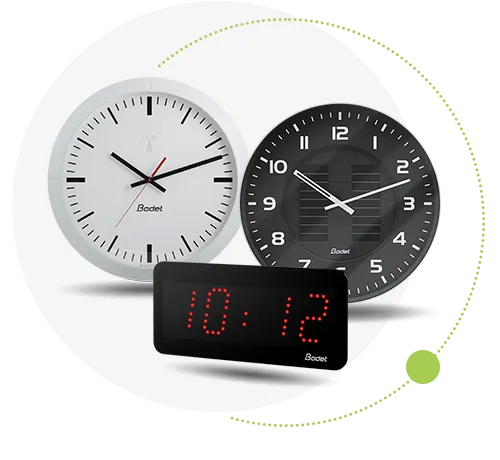
You could consider an analogue clock to be more traditional, given that it would have been invented before its digital counterpart. With two or three hands that rotate on a numbered or notched dial, its classic appearance suits many locations. They are particularly useful in schools, to help children learn how to tell the time.
Meanwhile, digital clocks are electronic displays showing time in a numerical format. They are more versatile than analogue clocks and able to display additional information - such as date or temperature- if desired via illuminated digits.
Location: indoors or outdoors?
Depending on where your clocks will be installed, certain models may be better suited to their environment than others. For outdoor locations, you’ll need clocks that are waterproof and built to withstand changing — and sometimes harsh — weather conditions. It’s also important to consider display visibility. In places like train station platforms, for instance, larger digits are essential so travellers can read the time quickly and easily from a distance, especially when they’re in a hurry.
The indoor environment matters just as much. In a hospital, for example, you’ll need clocks that are easy to clean, highly durable, and compliant with hygiene standards. It’s also worth considering whether the time needs to be visible from both sides, which may require a specific mounting method. In international banks or on trading floors, by contrast, clocks that display multiple time zones can be particularly useful.
As you can see, time management has become far more nuanced. Today, a wide range of clocks is available, each designed to meet the specific needs of different organisations.
Need help choosing the right clock system?
Why a Bodet Time clock system is the right choice for your organisation?
Bodet Time offers the expertise and the range of options you’re looking for. With more than 150 years in the industry, Bodet Time provides synchronised and standalone clock systems tailored to the needs of your specific sector — whether education, financial services, healthcare, manufacturing, industrial environments, transport, or sports facilities. Bodet Time’s master clocks meet all requirements, from entry level needs to advanced control of multiple systems, including heating and lighting.
Bodet Time’s clock systems use GPS or radio signals to synchronise, guaranteeing an accurate signal from the master clock to its slave clocks. They are quick and simple to set up, with distribution available via wired or wireless networks.
All Bodet clock systems meet ISO 9001 (product quality and reliability) and ISO 14001 (sustainable and eco-friendly manufacturing) standards. They are designed and manufactured in-house, using Bodet Group’s proven expertise in time management solutions.


