
Most organisations take time and the systems that provide and measure it for granted until something goes wrong. Often, it's an accumulation of smaller problems that creep in gradually: inefficiencies, lost production time, poor communication and safety risks. As these problems pile up, they can lead to bigger challenges.
It doesn't have to be a major catastrophe to make you realise your organisation has outgrown its clock system. As businesses evolve, it's essential that the systems they use keep pace and adapt to their changing needs.
Here are four signs that it might be time for you to rethink your clock system.

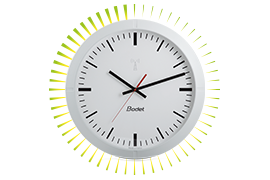
Delete manual settings from your clocks
Avoid time offsets by using synchronised clocks ensuring puntuality across your facility
Inconsistent time displays are causing operational friction
Accurate, consistent timekeeping is important whatever the size of the organisation or premises. Even in a relatively small business or office setting, clocks showing different times can create unnecessary challenges.
Staff may notice discrepancies between clocks in different departments, meeting rooms or buildings. This can leave everyone wondering which clock is showing the right time and undermine confidence in the time displayed. It can also raise questions such as:
- Are shifts starting and ending at the right time? Are employees clocking off too early or too late?
- Is your colleague late for your meeting, or has the meeting-room clock gained a few minutes?
- In healthcare environments, is confusion starting to creep in around staff coordination or procedure timings?
- Could someone be given an unfair disciplinary warning for being ‘late’?
These problems can affect more than just your internal day-to-day operations. If customers, visitors or other service users were to notice inconsistencies, it could undermine confidence in your organisation's professionalism and reliability. Sometimes, what internal teams consider to be a small detail could be unsettling to a potential customer.
The solution goes beyond simply resetting the clocks. Standalone clocks are prone to drift, meaning that even after being corrected, they can gradually begin displaying different times again. This can lead to confusion and disputes.
A synchronised clock system helps address these concerns by providing a single, accurate time reference across your site. Whether someone is in reception, a meeting room or the warehouse, everyone is working to a single, reliable time source.
Managing clocks is eating into valuable resources
Most of us find it annoying to remember to adjust the clocks in our homes twice a year when the clocks change. And that's even when you consider that some devices, like smartphones, change the time automatically.
Now imagine carrying out the same task across an entire business premises. Facilities and maintenance teams may be responsible for updating dozens or even hundreds of clocks spread across a site. Some may be mounted high on walls or above shelving or storage areas, making them difficult to access quickly and safely. Without a systematic approach, it's very easy to miss one or two. Every minute spent adjusting clocks is also time that could be used for business-critical work, such as planned preventative maintenance.
A synchronised clock system removes the need for manual adjustments. Seasonal time changes are managed automatically across the clock network by a master clock, ensuring that every clock updates simultaneously.
Your estate has become too complex for independent clocks
When your clocks were first installed, they may have served a single building or small site perfectly well. Now, your organisation may have doubled in size, added new buildings, opened a new branch or established a satellite office. Some organisations, such as universities or large healthcare sites, may also have buildings spread across a town or city. As your estate becomes more complex, maintaining accurate and consistent time across every location becomes increasingly difficult. What was once a simple task can quickly become a much bigger challenge.
A synchronised clock system allows you to maintain a single, consistent time reference throughout your organisation, regardless of its size or layout. Whether you choose a wired or wireless solution, synchronised systems are designed to scale and adapt as your organisation grows.
You need your time systems to support other infrastructure
Modern clock systems can do much more than simply display the time. They can help coordinate other systems across your organisation, acting as a kind of master timer behind the scenes.
With the right integrations, a master clock can help coordinate time-dependent systems such as heating, lighting and access control, allowing them to operate according to a consistent schedule. This can reduce the need for manual intervention, improve coordination and help keep day-to-day operations running smoothly.
Time synchronisation can also extend beyond your clocks. Bodet Time's Netsilon time server distributes accurate time across your network, helping computers and other compatible devices maintain a consistent time reference.
As your organisation's infrastructure becomes more connected, accurate time can play an increasingly important role in keeping everything working together.
What should I do if my organisation has outgrown its clock system?
If you're increasingly spending time resolving issues with your clock system or finding that it no longer meets your organisation's needs, it may be time to consider an upgrade. Start by reviewing your priorities: what do you need your clock system to do, and which features would best support your organisation's needs?
A synchronised clock system could be the best solution
Clock synchronisation co-ordinates clocks that would otherwise run independently, ensuring they all show the same, accurate time. This helps maintain consistency across your organisation, whether you have clocks in one building or spread across multiple sites.
A fully synchronised network uses a master clock to control it. This is a precision electronic device that sends reliable and consistent time signals to the clocks on its network. These networked (slave) clocks can be analogue or digital; both types can be synchronised.
When upgrading, do you need a wired or wireless clock system?
An additional consideration is whether to choose a wired or wireless solution. Both use a master clock to drive and synchronise the slave clocks on their network, helping them maintain accurate time. So, in that respect, there is little to choose between the two.
However, wired and wireless solutions distribute time signals in different ways. One type may be more suitable than the other depending on the size of your organisation and the number of slave clocks required.
- Wired clock systems use either dedicated cabling (Impulse, AFNOR/IRIG-B) or an Ethernet network using Network Time Protocol (NTP). A wired solution may be better suited to smaller organisations with fewer slave clocks.
- Wireless clock systems use a DHF radio signal, with GPS or Galileo available as time references depending on the system. Larger organisations, or those with multiple sites, can use signal repeaters to extend coverage across their premises.
Synchronised clock systems provide a reliable foundation for growth
As organisations grow, the systems that once worked perfectly can begin to show their limitations. Clocks are often overlooked, but inaccurate or inconsistent timekeeping can have a significant impact on many areas, including efficiency, communication, compliance and safety.
If you're experiencing any of the challenges discussed here, it's time to review whether your current setup is still meeting your needs and whether it will continue to do so as your organisation grows.
A synchronised clock system provides a reliable, scalable solution that gives everyone across the organisation access to the same accurate time source. It can help future-proof your organisation as it continues to grow.
Could your clock system be meeting your needs more effectively?
Since 1990, Bodet Time UK has been helping organisations maintain accurate, reliable timekeeping. Our experts can review your existing setup and recommend improvements tailored to your requirements. We offer a range of industry-specific solutions across education, logistics, healthcare, transport and manufacturing. All our clock systems are designed and manufactured in-house to meet ISO 9001 and ISO 14001 standards.
Get in touch with our team to discuss your project and discover how accurate, reliable timekeeping can support your organisation as it grows.


